



The CNC wood lathe is one of EagleTec's most popular cnc machines, and it's super handy for making all sorts of cool things like stair parts, balustrades, table and chair legs, Roman columns, and even baseball bats. What's great about this CNC lathe is that it can whip up a woodturning project in just about a minute! Since it's CNC-controlled, we need to program our designs ahead of time to create different styles of columns. In this course, we're excited to show you how to create a woodturning project drawing for your wood turning cnc machine. We think you'll really enjoy it and find it helpful!
EagleTec CNC provides high-performance woodturning cnc with full solutions from hardware to software, if you are looking for a new lathe, please check out here.
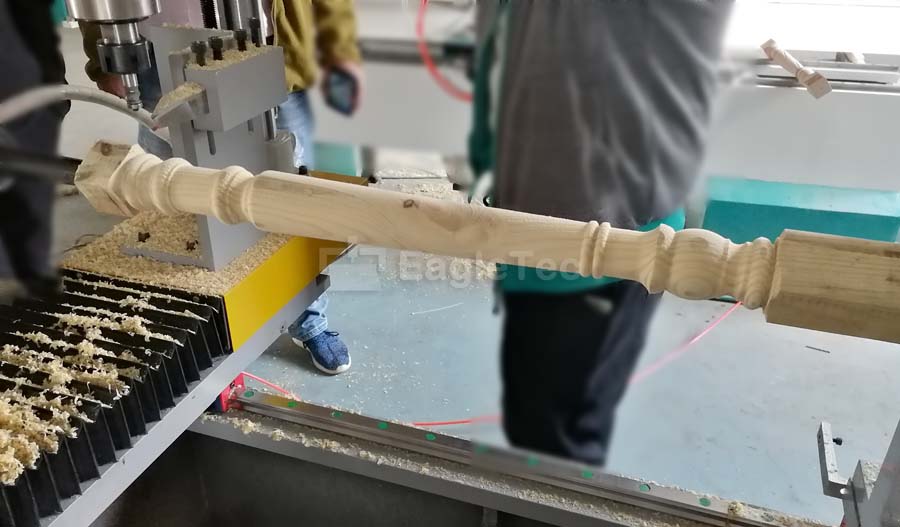
The EagleTec woodworking cnc lathe comes with a fantastic CNC controller that can directly read ***.dxf files. This means you can use AutoCAD as your programming software! Simply draw the outline of your project in AutoCAD, and once you're done, you can take those DXF drawings straight to the wood lathe for machining—no need to worry about creating G-code toolpaths. This user-friendly process makes it really easy for beginners to dive in and start programming woodturning projects.
Let's take a look at how to program step by step.
Let's say we have a woodturning blank in a square shape that measures 60 mm x 60 mm x 150 mm. Each side of the square is 60 mm long. If we do a little math, we can find out that the diagonal of the square is about 84.85 mm! This is because the diagonal is calculated by multiplying the side length by the square root of 2 (which is roughly 1.414). So, it looks like this: 60 mm x 1.414 ≈ 84.85 mm. Check out the diagram below for a better visual!
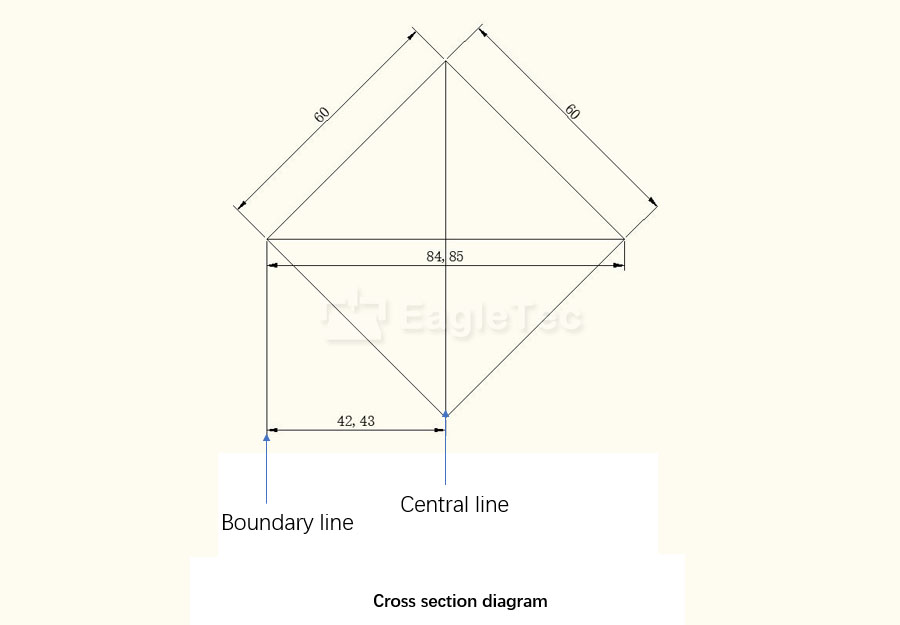
In woodturning, we get to enjoy creating symmetrical designs, which means we only need to draw the left half from the central line over to the left boundary. So, let's focus on the area between the left boundary and the central line for our design! The important measurement we're working with here is half of the diagonal, which is 42 mm. Just a friendly reminder: we should keep the maximum cut depth below 42 mm to avoid any breakage of the wooden blank. For a better idea of what we're aiming for, feel free to check out the sketch below!
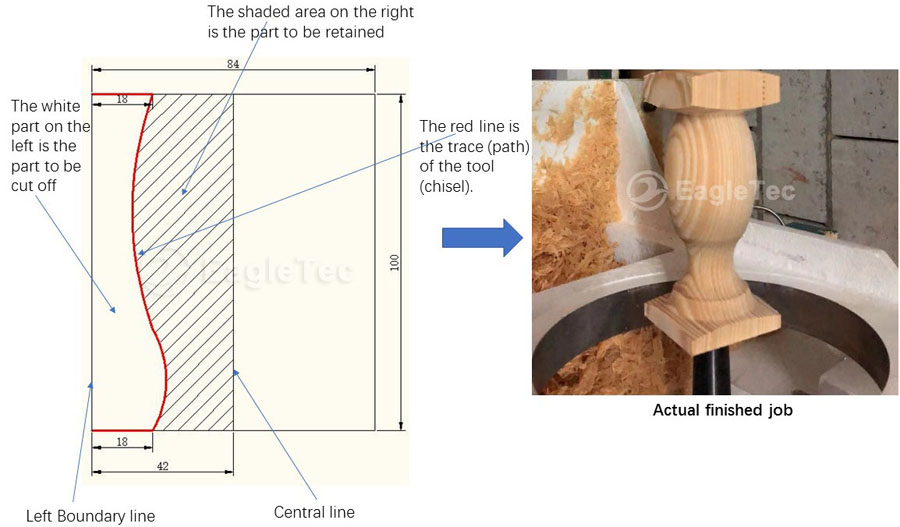
Take a look at the left half of the drawing above, and let's go over a few important points together:
• The white section near the left boundary line is the area that needs to be cut off by the machine.
• The shadowed part near the center line is what you'll want to keep.
• The solid red line shows the path that the woodturning tool (chisel) will follow.
• The measurement of 42 mm is half the length of the diagonal line.
• For the depth of your cuts, you'll want to use 18 mm for both the first and last cuts. (Feel free to adjust this based on your own needs!)
• The total length of the design is set at 100 mm. (Make sure to choose a length that's less than the wood blank!)
• Lastly, check out the photo on the right side; it shows the actual turned sample that corresponds to the drawing on the left.
First, open up AutoCAD and select the line tool. Don’t forget to activate orthogonal mode—it’ll help keep everything nice and straight! Now, go ahead and draw two lines that are perpendicular to each other, just like in the diagram below.

Let's get started by selecting the vertical line! Once you have that, use the offset tool and enter a value of 42mm, then hit Enter. Now, just click on the left side of the vertical line to create the offset line. This new line will beautifully mark the left boundary of your workpiece.

Let's start by selecting the horizontal line. Click on the "Offset" option and type in 100mm, then hit Enter. Now, click on the upper side of the line to create your offset line. This new line marks the end of your design pattern.
Next, think about how long you'd like your turning to be and enter that measurement. For instance, if you're aiming for a length of 100mm, just type in 100 here.
Great job! Now you've set the four boundaries for your woodturning design. Your pattern will be drawn within these boundaries, which you can see as the shaded area in the image below.

Create drawings within the four borders based on your product's shape.
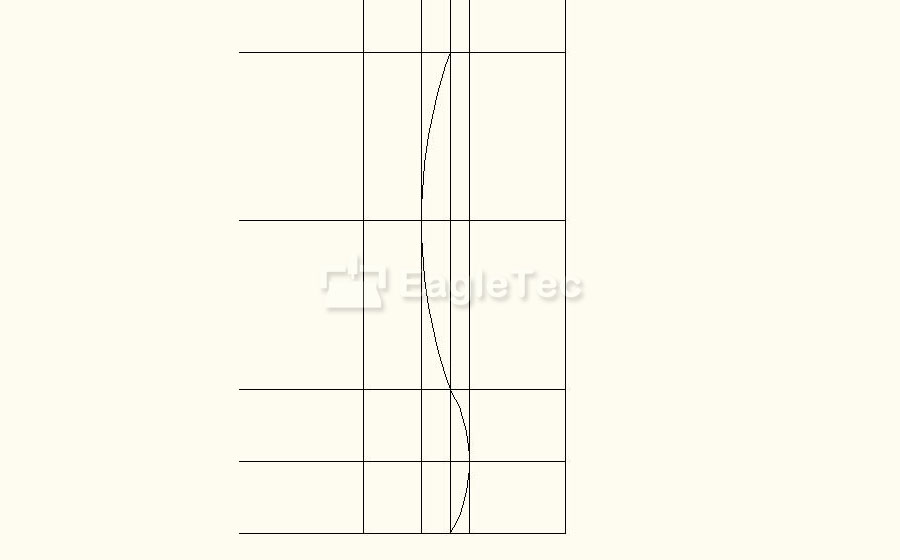
Now it's time to draw your guidelines! Start by marking the bottom and top lines, which will help you know where to begin and end your woodturning. Let's make sure the guideline is horizontal, starting from the left edge and reaching all the way to the outer contour of the product. Don't forget, we need one guideline at both the top and bottom ends.
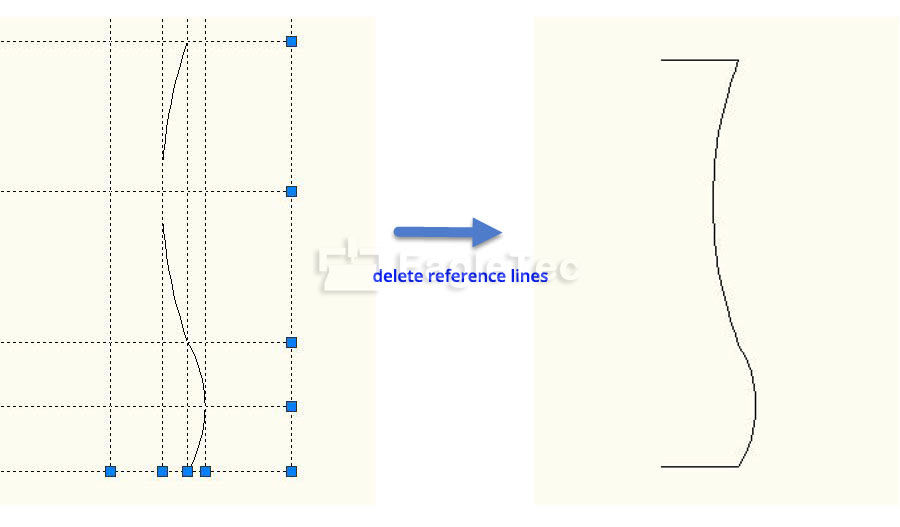
It's time to get rid of those reference lines. Your woodturning file is looking great and almost finished! Just one more step to go!
Let's get started by moving the coordinate origin to the lower-left corner of your finished pattern drawing.
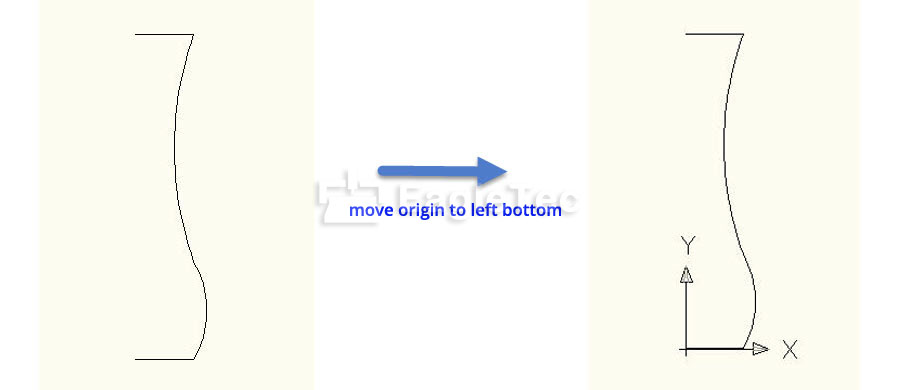
Great job on finishing your drawing! Now, go ahead and save it with the file extension ***.dxf. You're all set to take this programming file to the cnc wood turning lathe for machining. Happy crafting!
Hope you enjoy the course!
CNC Wood Lathe Hardware Tutorials Free Download
CNC Wood Lathe Programming Tutorials for Slot Broaching
Copyright: original works, for permission to reproduce, reprint, please be sure to indicate the form of hyperlinks to the original source of the article, author information, and this statement.
Copyright © Jinan EagleTec Machinery Co., Ltd. All Rights Reserved | Sitemap